Understanding the 'Planning for Two Lifetimes' Approach to Financial Security
Welcome back to the companion blog for the podcast! If you are a parent or caregiver of a child with special needs, you already know that navigating the world of parenting comes with a unique set of challenges, joys, and responsibilities. But there is one question that often lurks in the quiet hours of the night, casting a shadow over even the most peaceful moments: What happens to my child when I am no longer here to care for them?
It is a heavy, deeply emotional question, and it is completely normal to feel overwhelmed by it. Traditional financial planning simply does not cut it for families like ours. Standard retirement advice assumes a timeline that ends when you pass away, leaving your estate to adult children who can independently manage their own affairs. But for families raising a child with disabilities, our financial timeline looks entirely different. We have to plan for a future that extends far beyond our own mortality.
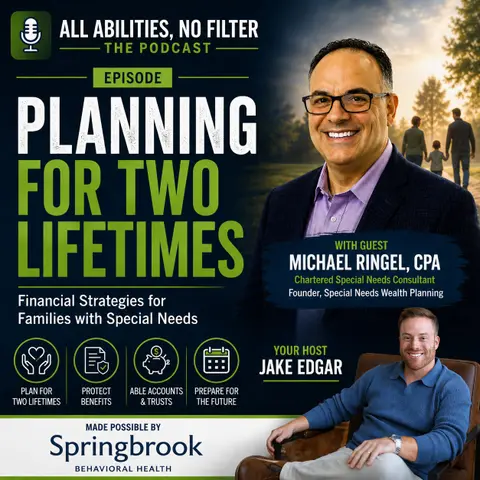
To help us break down this complex topic, I recently sat down with Michael Ringel, CPA, Chartered Special Needs Consultant, and Founder of Special Needs Wealth Planning, on our podcast. We explored his signature framework known as the "Planning for Two Lifetimes" approach. If you missed the conversation, you can listen to the full episode, Planning For Two Lifetimes: Financial Strategies for Families with Special Needs, right now. In this post, we are going to expand on those concepts, unpack the core philosophy, and provide you with actionable steps to start implementing this framework today.
Introduction: The Question Every Special Needs Parent Faces
Every parent wants to leave their children in a good position when they pass on. However, for parents of neurodivergent children or individuals with physical and intellectual disabilities, estate planning is not just about distributing assets—it is about ensuring continuity of care, housing, and financial security in a world that can be difficult to navigate.
Too often, families delay this process because the emotional barrier is simply too high. We do not want to think about a time when we will not be around. Furthermore, the sheer complexity of the legal and financial systems involved can lead to paralysis by analysis. How do you save for your own retirement while setting aside funds for a child who may need lifetime support? How do you leave money to your child without accidentally disqualifying them from vital government assistance?
These are the exact dilemmas that the "Planning for Two Lifetimes" approach aims to resolve. By shifting our perspective from short-term fixes to comprehensive, multi-generational planning, we can build a roadmap that offers genuine peace of mind.
What Is the 'Planning for Two Lifetimes' Approach?
At its core, the "Planning for Two Lifetimes" philosophy is a paradigm shift in how we view wealth management and estate planning. Instead of creating a financial plan that centers solely on the parents' retirement years, this approach forces us to look concurrently at two distinct timelines:
- Lifetime One: The parents' working years, retirement, and aging process.
- Lifetime Two: The lifetime of the child with special needs, which will continue long after the parents are gone.
Michael Ringel emphasizes that these two lifetimes cannot be separated. Traditional financial planners often look at your retirement nest egg and calculate how much you need to last until your life expectancy. But as a special needs parent, your financial obligations do not magically disappear when you pass away. In fact, that is often when your child’s financial needs become the most acute, as paid professionals may need to step in to provide the care, housing, and advocacy that you once provided yourself.
When you adopt the "Planning for Two Lifetimes" mindset, every financial decision you make—from buying a home and investing in the stock market to purchasing life insurance—is filtered through the lens of how it impacts both your retirement security and your child's long-term independence.
Protecting Government Benefits While Building Long-Term Security
One of the biggest misconceptions families have is that they should simply leave their hard-earned assets directly to their child in a will. While well-intentioned, this is actually one of the most dangerous mistakes you can make.
Many government programs that provide critical support for individuals with disabilities—such as Supplemental Security Income (SSI) and Medicaid—are means-tested. This means eligibility is strictly tied to the individual's income and assets. If your child inherits even a modest amount of money directly—say, ten thousand dollars—it can instantly push them over the asset limit, resulting in the termination of their medical benefits and monthly stipends.
Protecting these government benefits is a foundational pillar of the "Planning for Two Lifetimes" approach. You must ensure that any wealth you accumulate is transferred and managed in a way that supplements, rather than replaces, government-provided care. This requires sophisticated legal structures and a deep understanding of how public benefits policies work.
Essential Financial Tools: Special Needs Trusts and ABLE Accounts
To bridge the gap between building wealth and protecting government benefits, financial planners and estate attorneys rely on specific legal and financial vehicles. Two of the most powerful tools in your arsenal are Special Needs Trusts (SNTs) and ABLE Accounts.
Special Needs Trusts (SNTs)
A Special Needs Trust is a legal arrangement that allows a third party—such as a parent, relative, or professional trustee—to hold and manage assets for the benefit of your child without those assets counting against their government benefit eligibility. There are generally two types of SNTs:
- Third-Party Special Needs Trusts: Funded with assets belonging to people other than the beneficiary (like parents, grandparents, or relatives). Upon the child's passing, any remaining funds can be distributed to other family members or charities according to your wishes.
- First-Party (Self-Settled) Special Needs Trusts: Funded with the child's own money, often from an inheritance from an uninformed relative, a personal injury settlement, or accumulated savings. These trusts typically require a "Medicaid payback" provision upon the beneficiary's death.
ABLE Accounts (Achieving a Better Life Experience)
Authorized under Section 529A of the Internal Revenue Code, ABLE accounts are tax-advantaged savings accounts for individuals with disabilities. For many years, individuals with disabilities could not hold more than two thousand dollars in assets without losing benefits. ABLE accounts completely changed the game.
An eligible individual can own an ABLE account and accumulate significant savings—often up to one hundred thousand dollars or more, depending on the state—without jeopardizing their SSI or Medicaid eligibility. Furthermore, the earnings on investments within an ABLE account grow tax-free, and withdrawals are tax-free if used for "qualified disability expenses," which encompass a very broad definition including housing, education, transportation, employment training, healthcare, and basic living expenses.
Balancing Your Own Retirement with Your Child's Future Care
A common fear among parents is that fully funding their child's future will require them to sacrifice their own financial well-being during retirement. Conversely, some parents focus entirely on their own retirement lifestyle, leaving their child vulnerable later in life. Achieving the right balance is the tightrope walk of special needs financial planning.
Michael Ringel points out that ignoring your own retirement is actually detrimental to your child. If you run out of money in your seventies because you over-contributed to your child's immediate needs or mismanaged your portfolio, you may end up becoming a financial burden to your child and other family members later in life.
Instead, the goal is to optimize your savings strategy using holistic cash-flow modeling. By taking a close look at your income, expenses, and projected costs, a specialized financial planner can help you determine:
- How much you need to save for your own secure retirement.
- What specific insurance products, such as survivorship life insurance policies, can be used to fund the Special Needs Trust efficiently upon your passing.
- How to leverage employer benefits, catch-up contributions, and tax-advantaged accounts to maximize your overall household wealth.
Choosing the Right Trustee and Avoiding Costly Mistakes
Once you have set up your financial vehicles and trusts, you have to answer another critical question: Who is going to manage it all when you are gone?
Choosing a trustee is one of the most consequential decisions you will make. Many parents automatically default to naming an adult sibling to act as the trustee and caregiver. While this works wonderfully in some families, it can also place an immense burden on a sibling, potentially straining family relationships or creating conflicts of interest.
When selecting a trustee, you need someone who possesses a unique blend of financial literacy, emotional intelligence, and unwavering integrity. You should consider:
- Family Members: Ideal if they understand your child deeply, are financially responsible, and are willing to take on the administrative and fiduciary duties.
- Professional Trustees: Trust companies, corporate trustees, or specialized attorneys who can act as neutral third parties, manage investments professionally, and ensure compliance with complex trust laws.
- Co-Trustees: Pairing a family member who knows the child's personal needs with a professional trustee who handles the financial management and tax reporting.
Avoiding costly mistakes also means keeping your estate plan updated. Laws change, tax codes evolve, and your child's needs will shift as they transition from childhood into adulthood and eventually into their senior years. A static plan created twenty years ago can spell disaster today.
Actionable Steps Families Can Take Today for Peace of Mind
Reading about these concepts can feel inspiring, but the real magic happens when you take action. You do not have to fix everything overnight. Financial security is built through a series of intentional, manageable steps. Here is a practical roadmap to get you started:
- Write a Letter of Intent: This is a non-legal document that captures everything a future caregiver or trustee needs to know. Include your child's daily routines, medical history, behavioral triggers, favorite activities, dietary needs, and your ultimate vision for their happiness.
- Inventory Your Assets and Expenses: Get a clear picture of your current financial standing. Understand where your money is going and what resources you currently have available.
- Consult a Special Needs Financial Professional: Seek out professionals who hold designations like Chartered Special Needs Consultant (ChSNC) and who understand the nuances of disability planning. General financial planners may not be familiar with the intricacies of means-tested government benefits.
- Establish or Review Your Special Needs Trust: If you already have a trust, have an estate planning attorney review it to ensure it complies with current laws and correctly protects your child's future eligibility for benefits.
- Open an ABLE Account: If your child qualifies based on the age of onset of their disability, look into your state’s ABLE program and start contributing, even if it is just a small amount each month.
Conclusion: Taking the First Step Toward Lasting Security
Planning for the future can feel daunting, but you do not have to carry the weight of the world on your shoulders. The "Planning for Two Lifetimes" approach is designed to transform uncertainty into a clear, actionable strategy. By understanding how to protect government benefits, utilizing tools like Special Needs Trusts and ABLE accounts, balancing your own retirement needs, and choosing the right people to support your child, you can build a legacy of love, care, and financial stability.
Remember, taking even the smallest step today—whether it is drafting your Letter of Intent or scheduling a consultation with an expert—brings you one step closer to true peace of mind. You are your child's best advocate, and planning for their future is one of the greatest gifts you can give them.
To dive even deeper into this topic and hear expert insights directly from Michael Ringel, make sure to listen to our podcast episode, Planning For Two Lifetimes: Financial Strategies for Families with Special Needs. Stay tuned for future episodes as we continue to break down barriers, share expert advice, and build a supportive community for families of all abilities!